 how-to
How to Regulate Your Nervous System: A Step-by-Step Guide
Table of Contents
- Step 1: Recognize the Signs of Nervous System Dysregulation
- Step 2: Use Breathwork to Regulate Your Nervous System
- Step 3: Practice Somatic Exercises for Nervous System Regulation
- Step 4: Stimulate the Vagus Nerve for Lasting Calm
- Step 5: Explore the Benefits of Vibroacoustic Therapy and Other Recovery Tools
- Step 6: Build Consistency and Know When to Get Professional Support
- Frequently Asked Questions
Last Updated: October 1, 2026
Step 1: Recognize the Signs of Nervous System Dysregulation
Your body tells you when your nervous system is out of balance, but most people miss the signals that it's time to regulate nervous system function. Learning how to regulate nervous system function starts with spotting these clues early.
Nervous system dysregulation is when your body's stress response gets stuck in overdrive or shuts down entirely.
When it's not, you get stuck. Common signs include:
- Racing heart or chest tightness
- Trouble falling asleep or waking at 3 AM
- Feeling wired but exhausted
- Muscle tension in your neck and shoulders
- Irritability or emotional numbness
Hyper-Arousal vs. Hypo-Arousal: Two Sides of Dysregulation
Dysregulation shows up in two opposite ways. Hyper-arousal looks like anxiety, irritability, and a mind that won't shut off. Your sympathetic nervous system stays activated long after the threat passes.
The Freeze Response: What Most People Miss
Fight-or-flight gets all the attention. But the freeze response is just as common and far less understood.
Step 2: Use Breathwork to Regulate Your Nervous System
Breath is the fastest way to shift your physiological state. Unlike thoughts, you can control breathing directly, which gives you a direct line to your autonomic nervous system.
Diaphragmatic Breathing: The Foundation
Most adults breathe shallowly into their chest. This keeps the body in a mild stress state.
Diaphragmatic breathing uses your belly instead. Try this:
- Lie on your back with knees bent
- Place one hand on your chest, one on your belly
- Breathe in through your nose for 4 counts
- Feel your belly rise, not your chest
- Exhale slowly for 6 counts
- Repeat for 5 minutes
Physiological Sigh and Extended Exhale Techniques
The physiological sigh is a quick reset you can use anywhere. Take two short inhales through your nose, then one long exhale through your mouth. This pattern releases tension faster than steady breathing alone.
For deeper calming, try the extended exhale:
- Inhale for 4 counts
- Hold for 2 counts
- Exhale for 8 counts
Step 3: Practice Somatic Exercises for Nervous System Regulation

Grounding and Orienting Techniques
Grounding brings attention to physical sensations in the here and now. Try pressing your feet into the floor and noticing the pressure. Name five things you can see, four you can touch, three you can hear.
Progressive Muscle Relaxation
This technique teaches you to notice and release tension. You'll tense muscle groups one at a time, then let go.
Step 4: Stimulate the Vagus Nerve for Lasting Calm
The vagus nerve is the tenth cranial nerve, and it is the main highway of your parasympathetic nervous system. It originates in the brainstem, travels down both sides of the neck, and branches into your heart, lungs, and digestive tract. When vagal tone is high, your body shifts toward "rest and digest": heart rate drops, breathing slows, digestion resumes, and the inflammatory response quiets down.
Why These Techniques Work: The Mechanism
Roughly 80% of the fibers in the vagus nerve are afferent, meaning they carry signals up from your body to your brain, not down. This is the key insight. You are not "sending calm" to your body. You are sending physical signals (vibration, cold, slow exhale, vocalization) up the vagus nerve, and your brainstem interprets those signals as evidence that you are safe.
Techniques, With Actual Dosing
- Humming: Hum a single low note for the full length of one exhale. Repeat 10-15 times. The vibration in your throat and chest is the active ingredient, not the sound.
- Gargling: Gargle a mouthful of water for 30-60 seconds, hard enough to make noise. This is a stronger stimulus than humming because it engages the pharyngeal muscles more aggressively.
- Cold exposure to the face: Splash cold water on your face or hold a cold pack over your cheeks and eyes for 30 seconds. This triggers the mammalian dive reflex, which slows heart rate directly via vagal signaling. A full cold shower is a bigger stimulus but not required.
- Singing or chanting: Sustained vocalization for 5 minutes produces the same effect as humming with the added benefit of breath control. Chanting traditions across cultures have used this for centuries.
- Slow exhale breathing: Covered in Step 2, but worth noting here, a 2:1 exhale-to-inhale ratio is one of the most reliable vagal activators available.
According to research on vagal tone and stress regulation, higher vagal tone is associated with better emotional regulation, lower resting heart rate, and greater stress resilience. Vagal tone is trainable, it responds to consistent practice the same way a muscle responds to resistance training.
A Unique Angle: Match the Technique to Your State
Most articles treat vagus nerve stimulation as a single bucket. It is not. The right technique depends on whether you are hyper-aroused or hypo-aroused (see Step 1).
- If you are hyper-aroused (racing heart, anxiety, wired): cold water on the face, long exhales, and slow humming work best. These down-regulate an overactive sympathetic system.
- If you are hypo-aroused (flat, foggy, shut down): aggressive cold plunges can deepen the shutdown. Start instead with gentle humming, orienting (Step 3), and slow movement. You are trying to wake up the system, not sedate it further.
Step 5: Explore the Benefits of Vibroacoustic Therapy and Other Recovery Tools
Vibroacoustic therapy uses low-frequency sound vibrations to stimulate the body directly. You lie on a specialized surface while sound waves pass through you. The vibrations reach deep tissue and can help shift your nervous system into a calm state.
The benefits of vibroacoustic therapy include:
- Reduced muscle tension
- Improved sleep quality
- Lower stress hormones
- Deep relaxation without effort
Step 6: Build Consistency and Know When to Get Professional Support
Consistency matters more than intensity. Five minutes of breathwork daily beats an hour once a week, but "be consistent" is advice, not a system. Here is the framework most articles skip.
The Habit-Stacking Framework
Regulation practices fail for one reason: they are treated as a separate task instead of attached to something you already do. The fix is habit stacking, anchoring a new practice to an existing routine.
| Anchor (existing habit) | Stacked practice | Time needed |
|---|---|---|
| Morning coffee or tea | Diaphragmatic breathing | 5 minutes |
| Sitting down at your desk | Physiological sigh (3 rounds) | 1 minute |
| Walking to your car or transit | Grounding: name 5 things you see | 2 minutes |
| Getting into bed | Progressive muscle relaxation | 10 minutes |
| End of workday / closing laptop | Vagus nerve humming | 2 minutes |
The Two-Week Rule and the Minimum Viable Practice
Give any new practice two weeks before you judge it. Nervous system changes are cumulative and the first few sessions often feel like nothing is happening.
Tracking Without Obsessing
A simple checkmark on a paper calendar works better than an app for most people. You are tracking did I do it, not how well did I do it. If you miss a day, resume the next day, do not restart the count. Missing once is noise; missing twice is the beginning of a new pattern.
When to Seek Professional Help
- Symptoms that interfere with daily life, work, or relationships
- Panic attacks that keep happening
- Sleep problems that don't improve after several weeks of consistent practice
- Thoughts of self-harm
- A history of trauma that makes breathwork or body-based practices feel worse, not better
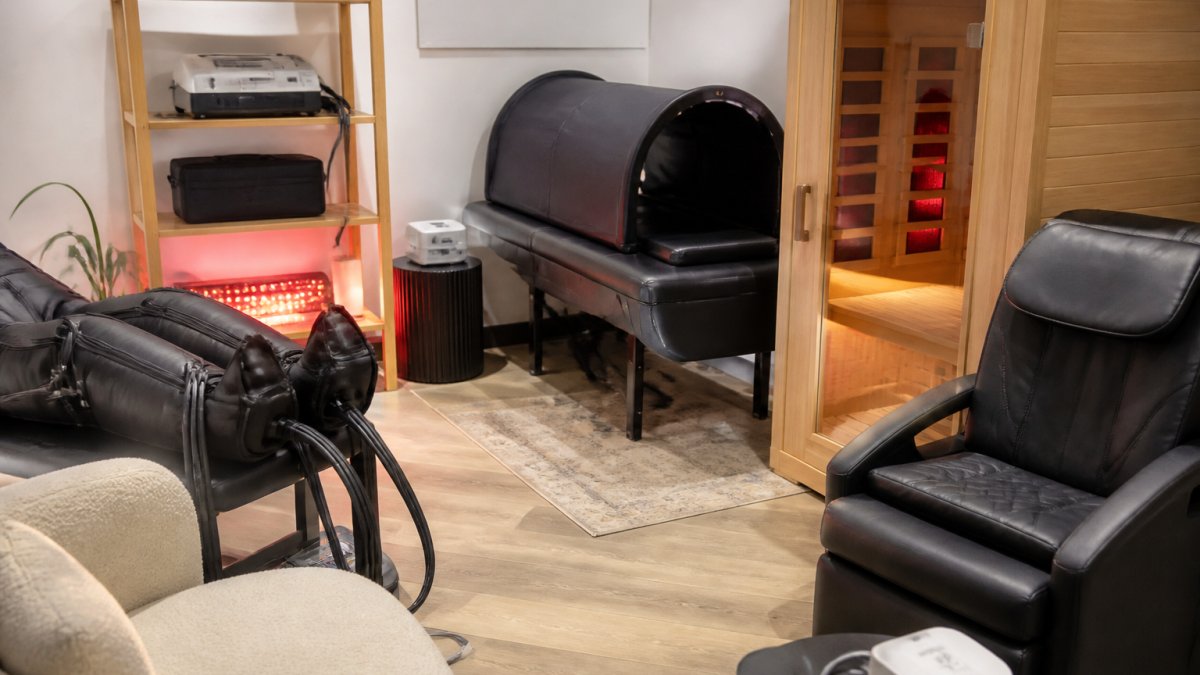
For those who want guided support, Unwind Longevity offers clinician-guided services through our telehealth partner. We also provide in-person treatments designed to help your nervous system reset.
Frequently Asked Questions
How do you fix a dysregulated nervous system?
Fixing a dysregulated nervous system starts with recognizing your state, then using targeted tools to shift it. Breathwork like diaphragmatic breathing activates the parasympathetic branch, while somatic exercises such as grounding help release stored tension. Vagus nerve stimulation through humming or gargling also helps. Consistency matters more than intensity. If you have persistent symptoms like chronic anxiety or sleep disruption, a professional evaluation can rule out underlying conditions.
What does a dysregulated nervous system feel like?
A dysregulated nervous system can feel like a constant edge: racing heart, shallow breathing, muscle tightness, or a sense of being 'wired but tired.' Some people experience the opposite, a flat, disconnected state with low motivation and fatigue. You might wake at 3 AM with your heart pounding or feel overwhelmed by small stressors. These signals mean your autonomic nervous system is stuck in a stress response, but they are not permanent.
How long does it take to heal a dysregulated nervous system?
There is no fixed timeline because nervous system healing depends on your history, stress load, and how consistently you practice regulation techniques. Some people notice better sleep and lower anxiety within a few weeks of daily breathwork and somatic exercises. For deeper patterns, it can take months. The key is regular practice. Working with a qualified practitioner can help you build an individualized plan and track progress over time.
Are vibroacoustic therapy and other wellness treatments safe for everyone?
Vibroacoustic therapy and similar treatments are not right for everyone. People with pacemakers, recent fractures, or certain medical conditions should consult a healthcare provider first. If you are pregnant or have a diagnosed neurological condition, check with your doctor before trying any new therapy. Always choose a provider that screens for contraindications and adjusts sessions to your needs.